News
Improving the Courtemanche Model: Unit Consistency and Intracellular Ion Dynamics
A recent update to the Courtemanche model in openCARP improves consistency with the original publication and the CellML implementation, corrects unit inconsistencies, and removes the previously fixed intracellular sodium concentration, (\([\mathrm{Na}^+]_i\)). These changes followed a detailed comparison of the openCARP and CellML implementations, which revealed inconsistencies in the formulation of the calcium-related flux term \(fn\) and the intracellular potassium concentration derivative, (\(\mathrm{diff_{Ki}}\)).
Correcting these inconsistencies has little effect on the action potential waveform during the first few stimulations. The main differences become apparent in the affected variables and in the long-term stability of the action potential waveform. As part of these corrections, several parameters were also renamed to ensure consistency with openCARP naming conventions.
Identifying the source of the discrepancies
The comparison showed that fixing \([\mathrm{Na}^+]_i\) stabilised the model only in combination with the incorrect calculations of \(fn\) and \(\mathrm{diff_{Ki}}\). However, this apparent stabilisation did not resolve the underlying inconsistencies in the model equations. After correcting these formulations, the simulations revealed a more pronounced shift in intracellular ion concentrations over time. Consequently, the fixed \([\mathrm{Na}^+]_i\) was removed to allow sodium dynamics to evolve freely and to avoid masking the effects of the corrected equations.
Correcting the formulation of \(fn\)
In the previous openCARP implementation of the Courtemanche model, a unit analysis identified an inconsistency in the first term of \(fn\), which involves the calcium release flux \(I_{\mathrm{rel}}\). This flux has units of \(\mathrm{mmol}/(\mathrm{L}\cdot\mathrm{ms})\), based on the calcium concentrations and the release rate constant. The associated scaling factor, \(C_{\mathrm{Fn1}}\), depends on the release-compartment volume and membrane capacitance. The product of \(C_{\mathrm{Fn1}}\) and \(I_{\mathrm{rel}}\) had units of \(\mathrm{mmol}/(\mathrm{ms}\cdot\mathrm{pF})\).
For the second part of \(fn\), the L-type calcium current and sodium--calcium exchanger current are expressed in \(\mathrm{pA}/\mathrm{pF}\). With the scaling constant \(C_{\mathrm{Fn2}}\), their products have units of \(\mathrm{mmol}/\mathrm{ms}\). This revealed an unintended factor of membrane capacitance in the first term.
This comparison revealed an unintended factor of membrane capacitance in the first term of \(fn\). The scaling factor \(C_{\mathrm{Fn1}}\) was therefore corrected for a membrane capacitance of \(100\,\mathrm{pF}\), changing its value from \(9.648\times10^{-13}\) to \(9.648\times10^{-11}\).
The equation was therefore changed to match the formulation in CellML.

Correcting the intracellular potassium concentration derivative
A second inconsistency was identified in \(\mathrm{diff_{Ki}}\), the rate of change of intracellular potassium concentration, \([\mathrm{K}^+]_i\). The original formulation yielded units of \(\mathrm{mmol}/(\mathrm{pF}\cdot\mathrm{L}\cdot\mathrm{ms})\), whereas the expected unit is \(\mathrm{mmol}/(\mathrm{L}\cdot\mathrm{ms})\).
The discrepancy arose because membrane capacitance was not accounted for correctly in the potassium concentration derivative, resulting in an additional, unintended capacitance factor in the units. In contrast, the corresponding calcium concentration derivative, \(\mathrm{diff_{Cai}}\), was already dimensionally consistent because membrane capacitance was incorporated into the scaling factor \(C_{\mathrm{B1d}}\) through \(C_{\mathrm{B1a}}\).

Evaluating the impact on simulated action potentials and ion concentrations
The corrected model was evaluated by comparing membrane potential and intracellular ion dynamics across the different model versions. The simulations examined both the first action potential and the evolution of \([\mathrm{K}^+]_i\) over longer periods, allowing immediate electrophysiological differences to be distinguished from progressive changes in intracellular ion concentrations.
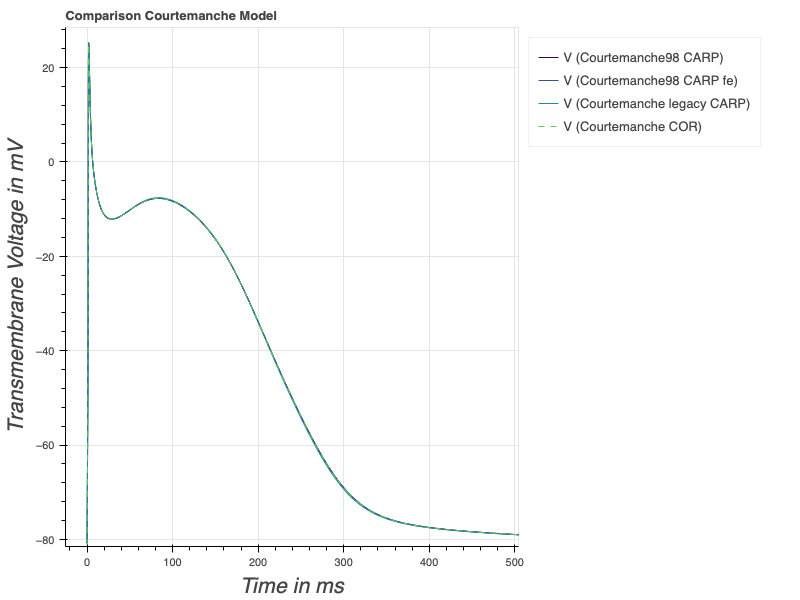 Figure 1: Transmembrane voltage of a single action potential.
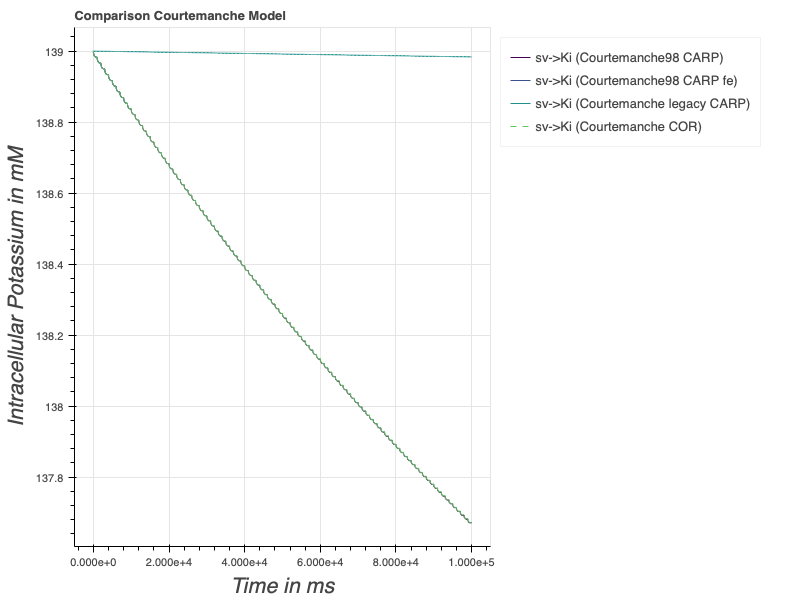 Figure 2: Intracellular potassium concentration after long-term pacing.
These comparisons help assess how the corrections affect action potential generation and the stability of intracellular ion concentrations over time. In particular, they allow the consequences of the corrected equations to be distinguished from the apparent stabilisation previously obtained by fixing \([\mathrm{Na}^+]_i\).
Summary
This update brings the openCARP implementation of the Courtemanche model into closer agreement with CellML, corrects the units and scaling of \(fn\) and \(\mathrm{diff_Ki}\), adds explicit unit annotations, and removes the fixed \([\mathrm{Na}^+]_i\).
For backwards compatibility, the previous model will remain in the
openCARP model repository for a while under the suffix _legacy. The
corrected model replaces the previous default version and can be
selected by choosing Courtemanche as the model to simulate.
Note: Long-term ion concentration drift
The drift in intracellular ion concentrations over time is a known
limitation of the Courtemanche model and is discussed in more detail by
van Oosterom and Jacquemet [1]. However, the model can approach a
nearly stable cycle length by pre-pacing it for approximately \(1,000,000\,ms\)
or longer using the openCARP --stim-assign functionality, with Ki
specified as the ion species, a --surface-to-volume ratio of 0.78,
and a stimulus strength of \(35\,\mathrm{pA}/\mathrm{pF}\).
During this process, \([\mathrm{K}^+]_i\) decreases while \([\mathrm{Na}^+]_i\) increases before both approach new values. The figure below shows the evolution of \([\mathrm{K}^+]_i\) alongside the transmembrane voltage during an action potential.
Although this approach can stabilise the cycle length, it does so at altered intracellular ion concentrations, which substantially affect the action potential waveform. This trade-off should be considered when using the Courtemanche model, particularly when interpreting results in the context of specific research questions.
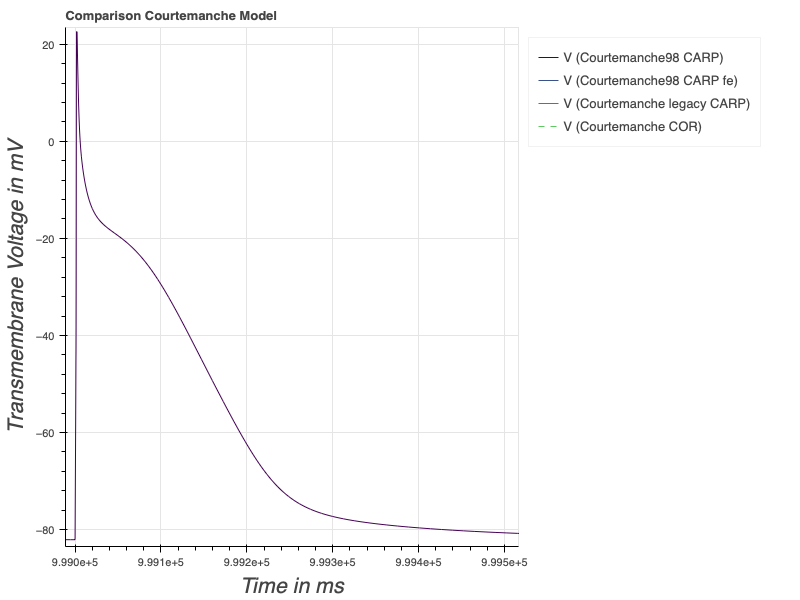 Figure 3: Transmembrane voltage during an action potential after long-term pacing.
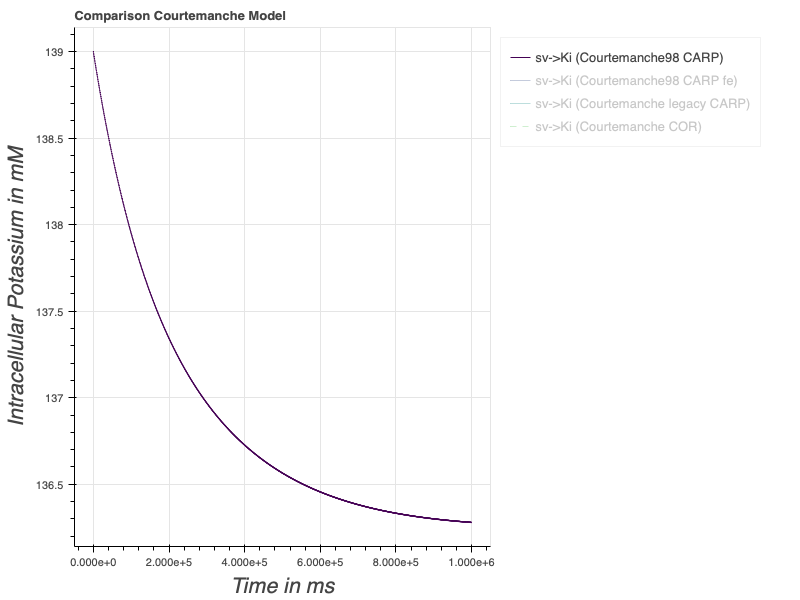 Figure 4: Intracellular potassium concentration after long-term pacing.
References
[1] A. van Oosterom and V. Jacquemet, "Ensuring stability in models of atrial kinetics," 2009 36th Annual Computers in Cardiology Conference (CinC), Park City, UT, USA, 2009, pp. 69-72.